

How Defense Technology Trends Are Shaping Material Requirements
While the best defense is the prevention of war, military competition, even confrontation, has historically been a significant driver of innovation. Current world conflicts have exposed major technological implications, such as:
- Increased vulnerability of military systems
- Shorter development and lifetime cycles of defense systems
- Increased use of smaller and less expensive devices in larger quantities (UAVs, drones)
- Further digitization and electronification across the defense sector
- Increasing importance of autonomous warfare
- Further development of missile and rocket technologies such as hypersonic missiles
These developments have led to predictions about the demise of highly complex, large, and expensive equipment such as battle tanks, warships, and combat aircraft. However, the latest assumption is that these large systems will instead be adapted to new requirements. This means that they are among the areas where the use of high-performance materials remains relevant. Emerging threats also necessitate the installation of additional technologies, which require the use of even more high-performance materials.
It is not always obvious where advanced materials are used or can be used, as their applications frequently involve very small components, or parts that are discreetly integrated or even invisible from the outside (such as sensors). These specialty materials are suitable for mission-critical applications such as drive technologies or electronics (C4ISR- Command, Control, Communications, Computers, Intelligence Surveillance and Reconnaissance). The increasing digitalization and electrification of defense, as well as miniaturization, have contributed to the fact that even the smallest military equipment and units, down to the soldier with their personal protective equipment, are part of this new integrated system. All of this would not be possible without suitable high-performance materials.
Recent trends are propelling technological advancements across all facets of military applications in the land, sea, air, space, and cyberspace, encompassing everything from microdevices for medicine, surveillance, and communications, to weapon systems and armor. Although space is not a new topic, it has gained importance recently due to the rapidly increasing use of satellites.
Materials used in defense applications include:
- High-purity beryllium, such as S200FH, combines exceptional strength and stiffness with high thermal conductivity and damping capacity. It is also suitable for nuclear applications.
- Beryllium-copper alloys, including Alloy 25, offer high strength and fatigue strength, resistance to stress relaxation and corrosion, and high electrical and thermal conductivity. They also resist hydrogen embrittlement.
- Copper-nickel-tin alloys, such as ToughMet® 3, combine high strength with toughness, resistance to stress relaxation and corrosion in various environments, and low wear and friction.
- Beryllium-nickel alloys, including Alloy 360, provide strength at elevated temperatures, high stiffness, excellent corrosion resistance, and toughness even at cryogenic temperatures. Alloy 360 also offers good ductility and formability, with stable electrical and thermal conductivity up to 350°C.
- Niobium-based alloys, such as C-103, offer very high strength and can be used at extremely low or high temperatures, with only a moderate decrease in physical properties as temperature extremes.
- Tantalum-based alloys, including ULTRA 76 Plus, provide superior corrosion resistance and retain their physical properties in extreme temperatures.
- Lightweight metal composites and alloys, including SupremEX® metal matrix composites, AyontEX® alloy, AlBeCast® MMC, and AlBeMet® AM162-H, offer high strength, fatigue strength and stiffness relative to weight. These materials have excellent thermal conductivity and low thermal expansion. AlBeMet composite also provides high damping capacity.
- Clad metals pair properties that a single material may not provide. Dovetail Clad® creates a tough copper-to-aluminum bond with low electrical contact resistance, while eStainless® clad combines excellent thermal conductivity with high strength, stiffness, and formability.
- Technical ceramics, including beryllium oxide (BeO) and aluminum oxide (Al₂O₃), provide temperature stability, corrosion and oxidation resistance, electrical insulation, and low weight. BeO also offers excellent thermal conductivity.
These specialty materials offer unique combinations of mechanical, physical, and technological properties, which are difficult to achieve with more standard, commonly-used materials.
Beryllium-copper alloys are a good example of this. They combine a variety of properties that, in most cases, even contradict the properties of the materials themselves (e.g., high strength combined with good corrosion resistance and good electrical and thermal conductivity).
Advanced materials can be used across a range of defense applications, including:
- Propulsion: Beryllium-copper alloys, copper-nickel-tin alloys, and aluminum-silicon-carbide composites can be used in engine components. Beryllium-copper and clad metals also support electric propulsion, while niobium alloy C-103 is used for rocket chambers and nozzles.
- Communications, electronics, and sensing: Beryllium-copper alloys, clad metals, tantalum, and technical ceramics have applications in antennas, connectors, capacitors, sensors, and wearable electronics. Optical mirrors and their support structures can use beryllium, metal matrix composites, or aluminum-silicon alloys.
- Energy storage and supply: Clad metals have applications in batteries and fuel cells. Nuclear reactor applications may use beryllium, beryllium oxide, aluminum-boron carbide, niobium, or tantalum.
- Thermal management: Metal matrix composites, aluminum-silicon alloys, and beryllium oxide can be used in heat spreaders. Beryllium-copper alloys, aluminum beryllium MMCs, and clad metals like eStainless clad also have heat sink applications.
- Protection and structures: Technical ceramics and composites have potential uses in body and vehicle armor and in protecting optics and sensors. Aluminum-silicon-carbide MMCs and advanced alloys like AyontEX AlSi can be used in fuselages, support structures, rails, and exoskeletons, while beryllium-copper alloys and copper-nickel-tin materials have applications in seals, sockets, and housings.
- Weapons systems: Depending on the component, advanced alloys, metal matrix composites, tantalum, and beryllium-copper materials can be used in wear parts, joints, and ammunition components. Optical and sensor assemblies may also use beryllium-based materials, aluminum-silicon alloys, or composites like SupremEX MMC.
Thanks to these diverse properties and combinations of properties, high-performance materials are relevant in all areas of defense. These include applications as diverse as small electrical connectors made of beryllium-copper, clad metals for bipolar plates for fuel cells, and niobium C-103 for nozzles for propulsion, as well as tantalum liners for EFP ammunition, to name just a few.
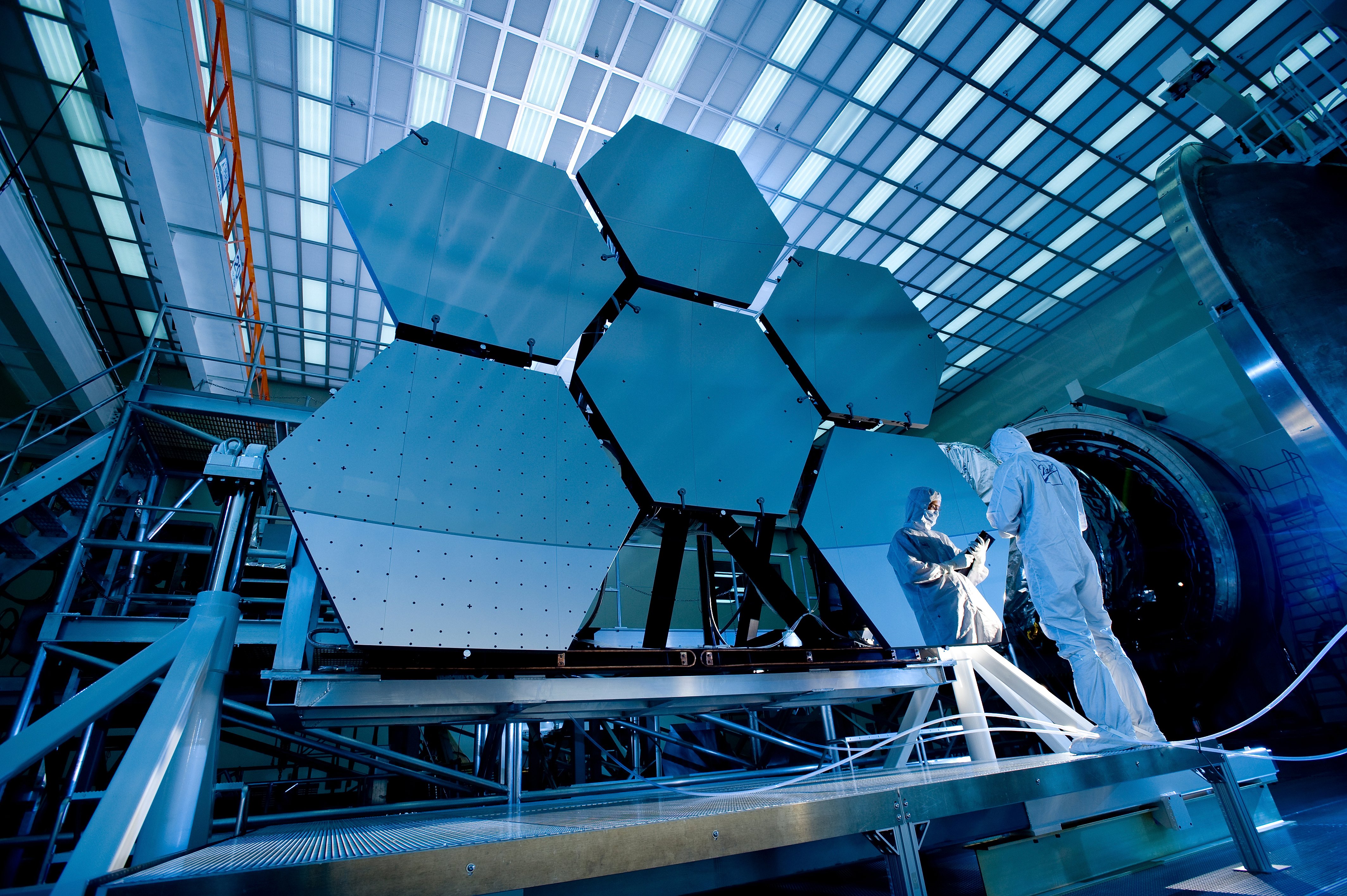
Figure 1: Hexagonal beryllium mirrors on the James Webb Space Telescope
The defense sector includes a long list of specialized applications, whose performance must be reliable, even under extreme conditions. Uses can be as diverse as lightweight fuselages for aviation, reflective optical systems for space-based systems, nozzles for propulsion in aviation, and nuclear devices (SMRs, nuclear batteries) for energy generation and storage.
To ensure that these critical applications are ready whenever they need to be, their components require the use of lesser-known high-performance metal alloys. These may include high-strength bronze (Alloy 25, ToughMet 3 alloy), niobium (alloy C-103), metal matrix composites, tantalum (ULTRA 76 Plus), or clad metals. The global conflicts of today do not render high-performance materials obsolete, but they do change the requirements, selection criteria, and specific application areas.