
Materion produces a variety of sputtering targets and evaporation materials used for thin film deposition in the manufacture of electronics. Many alloys are included in the product portfolio, which require major element compositional testing in addition to impurity testing and metallography.
Compositional tolerances of alloys become exceptionally tight when particularly repeatable device performance is required. To meet the tightest compositional specifications, the most accurate and precise analytical techniques must be used.
A common approach for composition testing is the dissolution of a sample in acid, followed by measurement with ICP-OES (inductively coupled plasma-optical emission spectroscopy). In this technique, dissolved samples are atomized and excited in a plasma and then , emitting UV and visible photons whose wavelengths correspond to different elements, and whose intensities correspond to concentration. ICP-OES measurements are routinely calibrated using NIST-traceable liquid standards with well-known concentration.
ICP-OES uncertainties depend on many factors but are limited by the fact that the method is based on the continuous physical destruction of both calibration standards and samples, and that the emission of light can depend on the concentration and identity of all components in a , along with environmental factors such as temperature and humidity.
To reduce measurement uncertainty, Materion developed High Performance (HP) ICP-OES, which utilizes several strategies to improve precision and accuracy. Such strategies include increasing the number of analytical replicates and optimizing the sample introduction hardware to minimize the effects of environmental fluctuations. Additionally, the OES wavelengths have been optimized, and the calibration approach has been customized for smaller alloy composition ranges. These improvements target both better accuracy and precision. For one alloy tested, the HP-ICP-OES method reached a 4x lower uncertainty than the corresponding regular ICP-OES method.
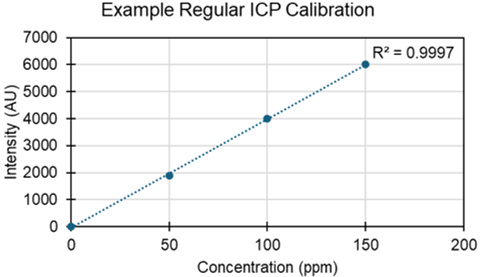
Typical ICP-OES calibration curve.
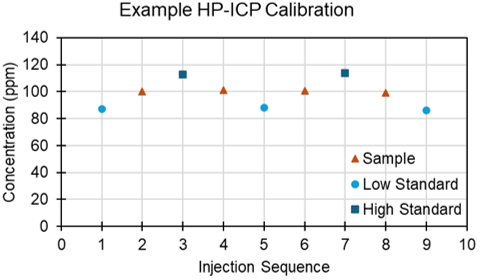
Example HP-ICP-OES calibration approach where calibration standards are run between every sample.
Although HP-ICP-OES offers significant improvements over ICP-OES for materials with tight specifications, there remains an inescapable calibration-to-calibration variability caused by the destructive nature of ICP testing and the unavoidable consumption of ICP standardization solutions. Further, HP-ICP-OES comes at the cost of longer testing time and higher testing costs and does not address the issue that some materials remain challenging to digest and get into solution.
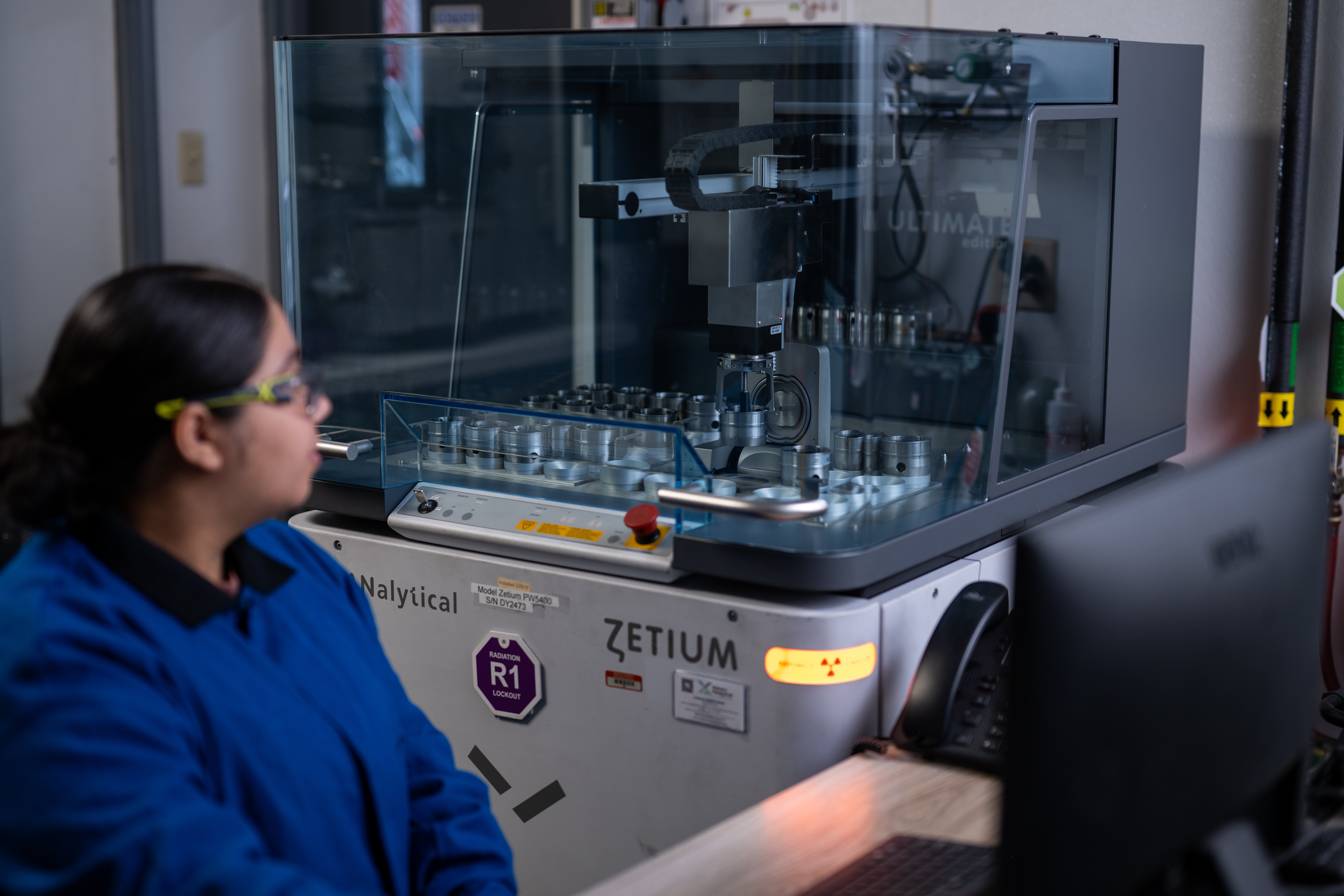
To overcome the calibration-to-calibration variability of ICP testing approaches, we have transitioned composition testing for some materials to Wavelength Dispersive X-Ray Fluorescence spectroscopy (WDXRF). In WDXRF, a metal sample is polished to a flat and smooth finish and irradiated with high power X-rays. Each element in the sample emits X-rays of unique wavelength, having intensities proportional to concentration, which allows for quantitation of the alloy’s composition.
Since WDXRF is non-destructive, identical calibration samples can be continuously used for years on end. This eliminates the calibration-to-calibration variability that ultimately limits ICP-OES precision. To address a potential pitfall of solid-state testing, the homogeneity of each alloy is evaluated during the method development process to ensure that it is suitable for solid-state testing with WDXRF.
Notably, analytical grade WDXRF instrumentation is extremely precise. WDXRF has distinct attributes compared to the related energy-dispersive XRF spectroscopy technique, which is often paired with scanning electron microscopy (SEM-EDS) or is found in handheld XRF instrumentation. The X-ray tubes used in WDXRF instrumentation have significantly higher power and better stability than those used in energy-dispersive XRF, allowing for ultra-precise measurements. Additionally, the optical components of WDXRF allow for much better resolution of different wavelengths and therefore much better identification of the elements.
WDXRF offers the ultimate in composition testing precision. Samples used for statistical quality control have measured standard deviations under 0.02 wt% for over one year of analysis and the precision of WDXRF can be 10x better than for HP-ICP-OES.
Materion’s WDXRF instrument.
Given the breadth and uniqueness of materials manufactured by Materion, there is often a lack of solid-state certified reference materials for calibrating WDXRF methods. Therefore, we use our HP-ICP-OES capabilities to thoroughly characterize in-house standards, providing NIST-traceable WDXRF calibrations.
Depending on the material characteristics and specification requirements, HP-ICP-OES and WDXRF offer needed improvements in precision and accuracy. Customers requiring the tightest material specifications are invited to discuss the best testing options with the sales, engineering and analytical teams.